

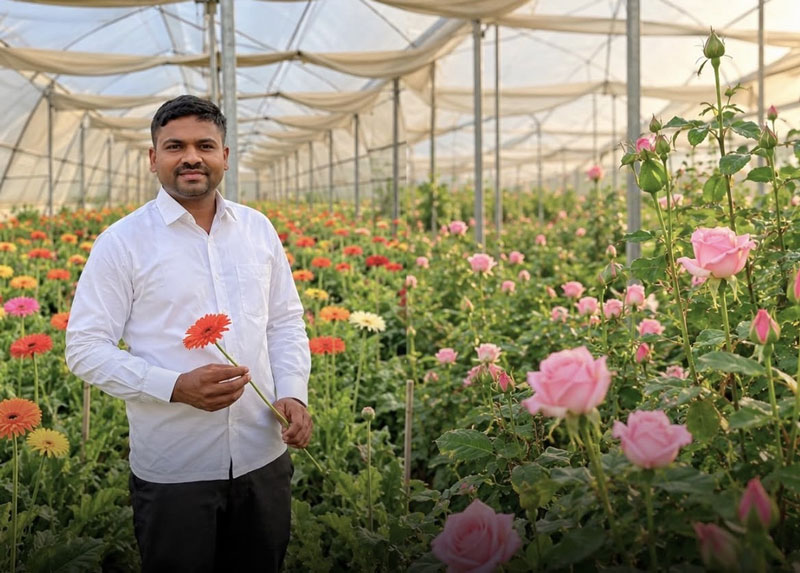
What if a single acre could generate a steady stream of income instead of forcing a farmer to wait months for one harvest? In Maharashtra’s Ahilyanagar district, farmer Arjun Sabale has built a flower-farming model around that idea, growing roses and gerberas inside a naturally ventilated polyhouse. According to 30Stades, Sabale earns around Rs 12,000–13,000 a day from the two crops, while his monthly turnover is above Rs 3.5 lakh and his reported net profit is nearly Rs 2.5 lakh. Scroll down to find more details.
How did a Maharashtra farmer turn one-fourth acre into a flower business?
Sabale grew up in a family that cultivated marigolds and chrysanthemums. However, falling prices and oversupply pushed him to look for an alternative. While studying agriculture, he visited different farms and became interested in protected cultivation. In 2016, he started growing roses on about 10 guntha, or one-fourth of an acre. His first experiment produced about 500 roses a day. At an average selling price of Rs 5 per flower, the small plot generated roughly Rs 2,500 a day, according to his account. That encouraged him to expand and eventually add gerberas.
Maharashtra farmer now grows 32,000 plants on one acre
Today, Sabale has divided his one-acre farm between roses and gerberas, with around 16,000 plants of each. He says the farm produces approximately 1,000 roses and 2,000 gerbera flowers every day. At the reported rates of Rs 5 per rose and Rs 4 per gerbera stem, the two crops together can generate around Rs 13,000 in daily sales. However, Sabale puts his daily earnings more conservatively at around Rs 12,000. His reported monthly expenses, including labour, fertilisers, pesticides and packing material, are around Rs 1 lakh.
Why did he choose a low-cost polyhouse?
Instead of investing in an energy-intensive climate-controlled structure, Sabale uses a naturally ventilated polyhouse. The system uses roof vents and side curtains to encourage airflow, reducing the need for cooling fans and electricity. His first 10,000-square-foot structure reportedly cost around Rs 3 lakh when it was installed in 2015-16. The approach also reflects the wider push towards protected cultivation. ICAR-DFR scientists in Pune have recently worked with Maharashtra rose growers on sustainable protected cultivation, recommending practices including fertigation, biological inputs and integrated pest management. The institute said that “scientific management practices contribute to better productivity and economic returns.”
Gerbera farming is already established in Maharashtra
Sabale’s experience is not an isolated example of protected floriculture in the state. The Indian Express previously reported how farmers in drought-prone Osmanabad adopted protected gerbera cultivation, with the number of polyhouses in the district rising from 29 to 266 between 2014 and 2017. Padoli village alone had more than 20 gerbera polyhouses at the time. ICAR has also documented protected cultivation of gerbera and roses as a route towards higher farm revenue and employment.
From flowers to daily cash flow
For Sabale, the biggest difference is the frequency of income. Unlike crops that may take months before harvest, roses and gerberas can be picked regularly. He also sells through multiple channels, supplying local flower stalls and larger markets. Gerberas are transported to cities including Mumbai, Bengaluru, Ahmedabad, Vadodara and Hyderabad depending on demand. His story illustrates how crop diversification, protected cultivation and direct market access can change the economics of a small farm. Rather than simply expanding the acreage, Sabale has focused on getting more value from the land he already has, turning one acre into a year-round flower business.
